Reading - Practical Example
Does this complaint seem familiar to you?
"I understand every word of that sentence, but can’t put them together so that they make sense."
This is a typical experience for those who learn isolated vocabulary. The best way to learn new words is to learn them in the context of a text, which is why I combine this step with the next one called Reading.
→ Chunks that are 2–4 words long will not only help you memorize words better, but also retrieve them faster in conversation. There is no benefit in knowing thousands of words when one can’t retrieve them when needed. Here is one example to illustrate the power of context:
the German word Bank (f*) ❶ is a so-called homograph. It could mean either bench or bank (i.e. the institution dealing with money) or even river bank or reef. While you might eventually have to learn several meanings of Bank you don’t have to do so at once. If you read the two sentences:
Er geht in den Park und setzt sich auf eine Bank.
He goes into the park and sits himself onto a bench. ❷
Hans arbeitet bei einer Bank.
Hans works at a bank
You would very easily be able to figure out which meaning of Bank you are dealing with, even if you didn’t have any translation at hand: the words » Park« and »setzt sich« would provide sufficient context to figure out that Bank in this context means bench. You would also have associated the new word with a little background story. Suitable chunks might be:
sich auf eine Bank setzen
bei einer Bank arbeiten
Or
Heidi setzt sich auf eine Bank.
Peter arbeitet bei einer Bank.
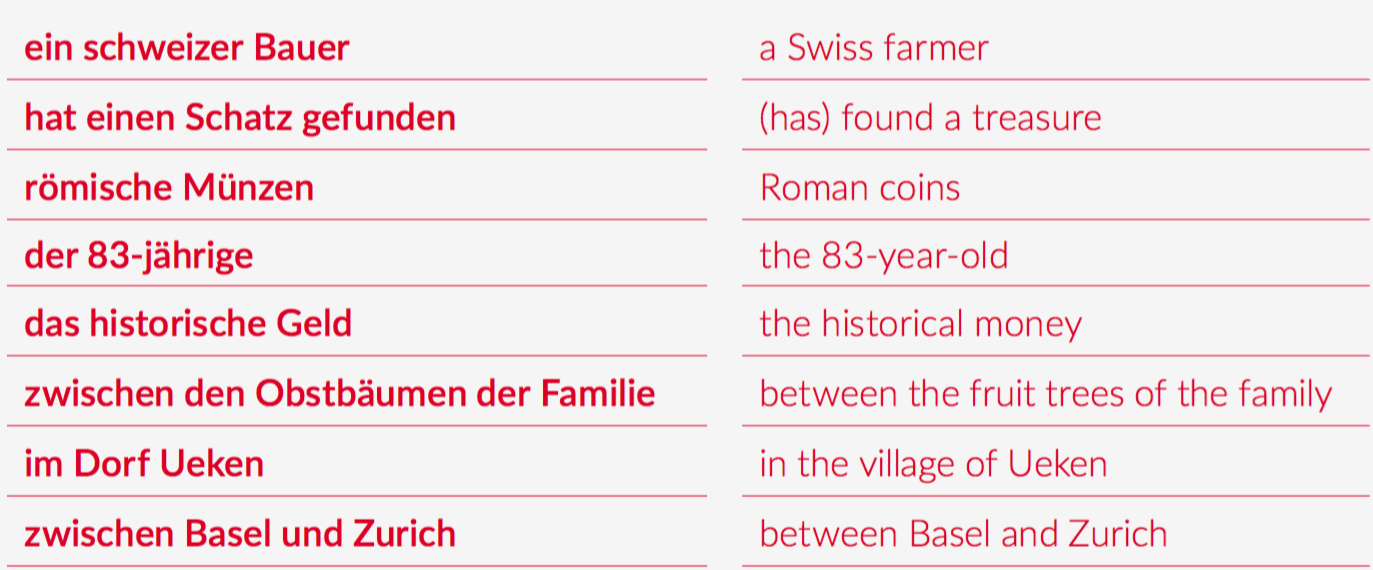
It might seem that you have to learn more words than with the classical wordlist approach, but the additional information actually helps you recall it much more easily and quickly when needed. Here's an example of a chunky vocabulary list: